
Universal services through public ownership of essential industries, ending the cost of living
Replace RBA and all commercial banks with a single fee-free Public Bank
Fairer taxing of productive wage labour versus passive wealth accumulation
A Green New Deal transitioning to 21st-century low-emissions industries
End bribery and strengthen consensus decision making

Your Taxes Pay for Nothing | PEGS Institute, 2020
They never have and they never will. Nobody likes paying taxes, so if the government doesn’t spend your taxes, what are taxes for? This video busts a few myths about how taxes work and explains some of the real uses of tax in modern economies.
Tax is not theft: why the “it’s my money” argument is wrong | Richard J Murphy, 2025
Is tax theft? Many people think so — and that belief shapes how we vote, how we treat public services, and how democracy functions. In this video, I explain why the popular claim “it’s my money, why should the government take it?” is based on a fundamental mistake. Income does not exist before the state. Jobs, wages, money, contracts, and property rights all depend on government systems that come first.Tax is not punishment. It is not confiscation. It is a macroeconomic tool that stabilises the economy, controls inflation, shapes markets, reduces inequality, and sustains democracy itself. If you care about public services, economic stability, or democratic accountability, this is the conversation we need to have.
Professor Stuart Kells, University of Melbourne (click to view article)
Modern monetary theory (MMT) may seem complex at first, but in fact it is remarkably simple. As MMT economists have long pointed out, governments are not like households. They do not have to ‘earn money’ (through, say, taxing or borrowing) in order to spend. They can create money for public spending, simply by issuing currency and expanding the deficit. This is not a hypothetical scenario. It is how governments actually work. They fund public services and public employment by creating money. And they do not have to worry about ‘balancing the budget’, because they cannot become insolvent in their own currency.
Of course, there are limits to money creation. If you spend too much money into the economy, demand may overwhelm the country’s productive capacity, which risks driving excess inflation. But if this happens there’s a simple solution: you can use industrial policy to expand capacity where necessary, and you can tax excess money back out of the economy, starting with the richest in society. According to MMT, the purpose of taxation is not to fund government spending – as governments can fund spending simply by issuing currency – but rather to reduce excess demand, and, as an important side effect, to reduce corrosive inequality.
MMT opens exciting possibilities for an alternative economic model, where the national currency is used to mobilize domestic resources and labour to accomplish human development. To do this, governments can simply issue money and spend it on achieving [social] goals.
Jason Hickel, How to achieve full decolonization
The Big Myth of Government Deficits | Stephanie Kelton, 2022
Government deficits have gotten a bad rap, says economist Stephanie Kelton. In this groundbreaking talk, she makes the case to stop looking at government spending as a path towards frightening piles of debt, but rather as a financial contribution to the things that matter -- like health care, education, infrastructure and beyond. "We have the resources we need to begin repairing our broken systems," Kelton says. "But we have to believe it's possible."

Ray Maxwell, RadioMMT #064 Austerity Is Murder & Other MMT Revelations
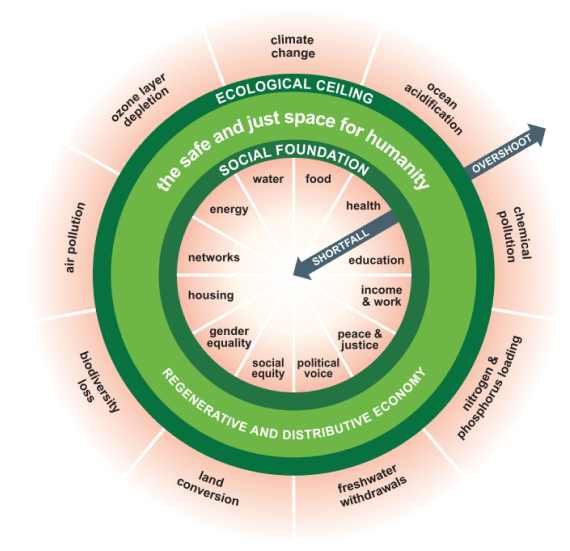
The Doughnut of Social and Planetary Boundaries - Doughnut Economics Action Lab
A healthy economy should be designed to thrive, not grow | Kate Raworth, 2018
What would a sustainable, universally beneficial economy look like? "Like a doughnut," says Oxford economist Kate Raworth. In a stellar, eye-opening talk, she explains how we can move countries out of the hole -- where people are falling short on life's essentials -- and create regenerative, distributive economies that work within the planet's ecological limits.
The Hidden Price of "Progress" | Our Changing Climate, 2025
Examine whether capitalism has actually driven progress, and examine the claim that capitalism is a net-positive force in the world. I zoom in to the level of New Optimists like Bill Gates and Steven Pinker to explore whether we are living better lives than before.
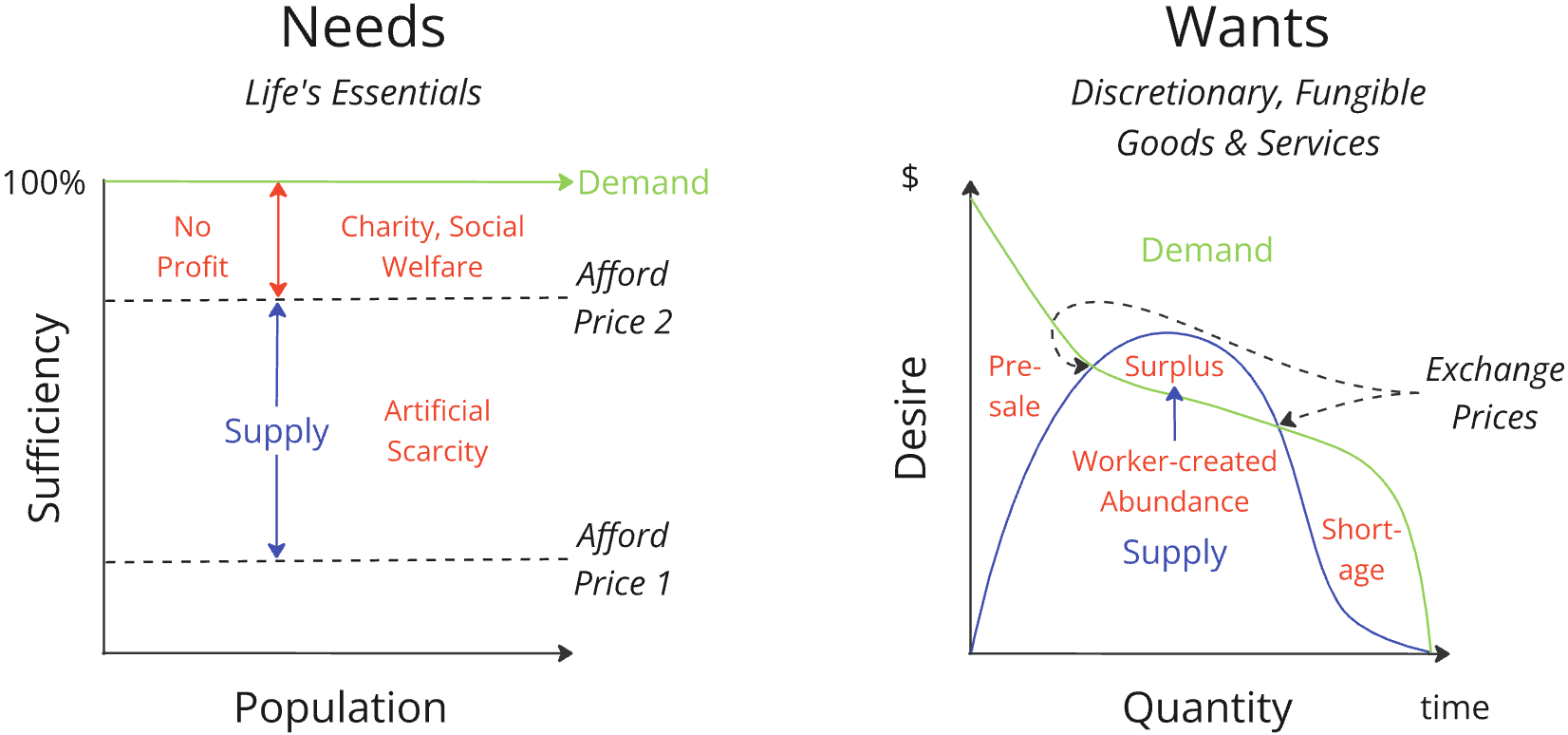
Supply/Demand reimagined when based on Maslow's hierarchy of needs
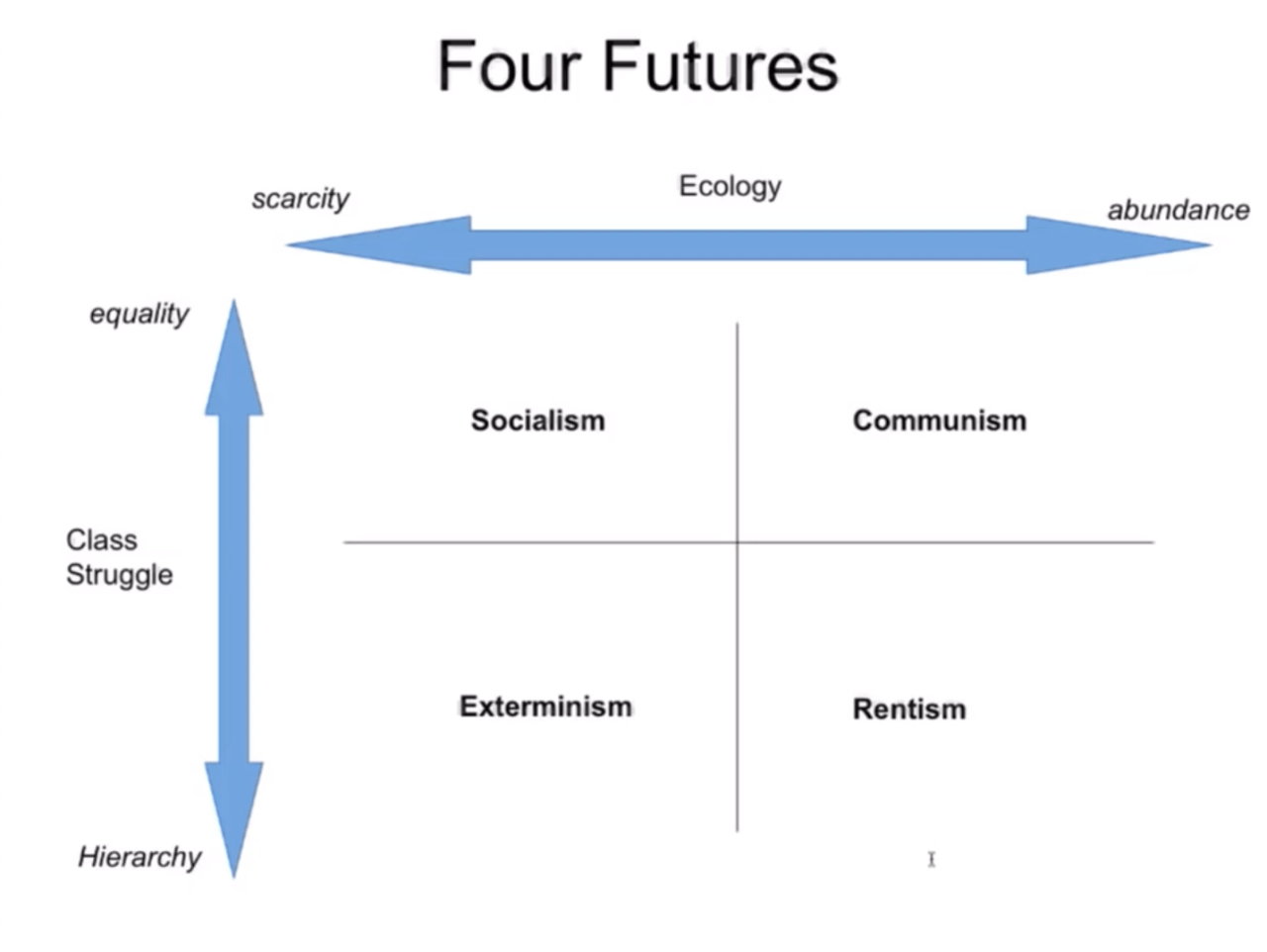
In Peter Frase's 2016 book Four Futures: Life After Capitalism he proposes four radically different societies dependent on how well we deal with ecological and technological change. Frase suggests humanity is at a fork in the road, defining four futures (two dystopian, two utopian) across ecological and class struggle scales, i.e. Exterminism (Scarcity | Hierarchy), Rentism (Abundance | Hierarchy), Socialism (Scarcity | Democracy) and Communism (Abundance | Democracy). Essentially, society will tend towards either utopian or dystopian extremes depending on the level of class equality and ecological sustainability.
Four Futures: Life After Capitalism (Book Review & Summary) | Prosocial Progress Foundation, 2017
A summary of the book 'Four Futures: Life After Capitalism', written by Peter Frase. Areas which are explored: Potential future societies such as communism, socialism, rentism and exterminism.
What Happens After Capitalism? | Our Changing Climate, 2025
Examining what ecosocialism might look like in the future. From zero-carbon, accessible, and free public transit, to low-cost housing, all the way to a planned economy, an ecosocialist future would seek to bring better well-being to all people and the planet.
Why Capitalism Can’t Save Us | Jason Hickel on Climate, AI & Empire | Michael Mezzatesta - Better Future, 2025
Why a growth-based capitalist economy is incompatible with a livable planet, and what a truly democratic, post-capitalist economy could look like. We cover lots of topics – including degrowth, AI, the history of capitalist imperialism, and how to achieve a democratic ecosocialist transition.
Any comments or queries are welcome via johnkempen@me.com